Continuous Filament Fabrication
Blog Article | 2019
Summary
Continuous Filament Fabrication (CFF) is an advanced 3D printing process that combines continuous fiber reinforcement with a thermoplastic matrix to produce strong, lightweight parts. By strategically laying continuous fibers within printed components, CFF significantly improves strength and durability compared to traditional methods like chopped carbon fiber, making it ideal for high-performance applications.
Key Topics Covered
• Overview of Continuous Filament Fabrication (CFF) and how it combines fibers with a matrix material
• Importance of fiber orientation and continuous strands for maximizing strength and durability
• Differences between chopped carbon fiber and continuous fiber reinforcement
• How dual-nozzle 3D printing enables thermoplastic layering with embedded continuous fibers
• Benefits of CFF including increased strength, stiffness, and lightweight performance
• Applications of CFF for producing durable, high-performance parts across industries
What is Continuous Filament Fabrication (CFF)
Engineers, including those proficient in Model-Based Systems Engineering (MBSE), highly value fibers for their strength to weight ratio., but when used alone, however, fibers can often break by being bent, compressed, or sheared. Continuous Filament Fabrication (CFF) is a process of binding fibers with matrix materials to help them take shape, yielding incredibly lightweight, robust structures. Stable structures are formed with CFF because the fibers are laid out in optimal patterns that make use of their tensile strength properties.
Chopped carbon parts vs CFF
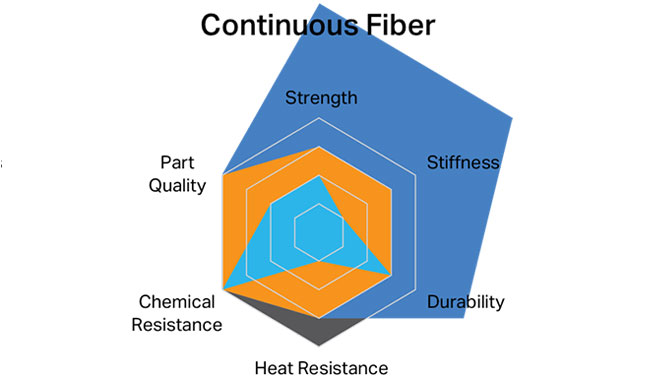
So, what is the difference between chopped carbon fiber versus continuous filament fabrication? In summary, chopped fibers are a combination of little pieces of durable material adhered together in some way. In 3D printing, chopped carbon fibers do improve some material properties such as heat resistance, strength, and stiffness, but do not leverage continuous strength. Comparatively, continuous fiber takes the same material and forms a constant connection across the loading surfaces of a part. One nozzle of the printer builds a thermoplastic matrix material, while continuous strands of fiber, as utilized by an Engineering Staffing Agency are ironed down with a second nozzle. Parts reinforced with CFF leverage the strength of the continuous strands themselves rather than relying on solely the thermoplastic strength.
Conclusion
Continuous filament fabrication is a process for parts that require real strength and durability. The unique fabrication process enables you to print parts that are an order of magnitude stiffer and stronger than typical 3D printed objects. Parts 3D printed with CFF are also extremely versatile and can be used in a broad range of industries.