

A Look at the Markforged Mark Two (Gen 2) 3D Printer
Blog Article | August 24, 2023
Markforged introduced the Continuous Fiber Fabrication (CFF) process in 2014 with the Mark One 3-D printer. It featured a dual extruder system combining CFF with traditional 3-D printing. Designers could use fiberglass, carbon fiber or Kevlar for the CFF process, and nylon for 3-D printing.
The Mark Two Enterprise came on the scene in 2016, with a redesigned composite printing system that created stronger, higher-quality parts. It’s 40 percent faster than the Mark One, on average, and can reinforce much smaller parts.
Now Markforged has introduced the Mark Two (Gen 2). Let’s look at how this model improves on previous versions.
Markforged 3D Printers & 3D Printing Capabilities
Markforged changes what you know about a 3D printer and metal printing. Markforged 3D printers transcend the realm of 3D printer prototyping and trinkets. Find the right Markforged 3D printing solution for your needs!
Markforged Mark Two 3D Printer at a Glance
The Markforged Mark Two (Gen 2) builds on the proven Continuous Fiber Fabrication (CFF) platform with meaningful performance, reliability, and usability improvements over earlier generations.
-
Faster Continuous Fiber Printing
Prints continuous fiber parts approximately 40% faster on average compared to the Mark One, helping teams move from design to functional parts more quickly. -
Reinforcement of Smaller Parts
Capable of reinforcing up to 15x smaller parts, enabling stronger, lightweight components for intricate designs and compact tooling that weren’t previously feasible. -
Improved Print Reliability
Enhanced reliability through integrated sensors and hardware/software upgrades, delivering more consistent print results, reduced failures, and better repeatability for production-ready parts.
Together, these upgrades make the Mark Two (Gen 2) a more capable and dependable composite 3D printer for engineering prototyping, tooling, and low-volume manufacturing applications.
Materials & System Details
The Mark Two is a precision-designed desktop printer suitable for a range of manufacturing and engineering applications. With an intuitive touchscreen interface, it’s easy to set up, operate and maintain. The print bed clicks in place with 10 µm accuracy, enabling designers to pause a print job, add components, and continue printing.
Security features include administrator access, two-factor authentication, and single sign-on.
Materials & Properties
In addition to fiberglass, carbon fiber and Kevlar, designers can choose high-strength, high-temperature (HSHT) fiberglass. HSHT fiberglass isn’t as stiff as carbon fiber but works well for parts used in high-temperature environments.
Thermoplastic material options include the Markforged Onyx filament, a nylon combined with chopped carbon fiber. Onyx is 40 percent stronger than ABS, has an excellent surface finish, and is chemical and heat resistant. The new Markforged Precise PLA is cost-effective thermoplastic for design validation. It comes in a variety of colors and prints without warping. Designers can also use the new Markforged Smooth TPU 95A, a rubber-like material that’s ideal for seals, gaskets, straps, belts and more.
Markforged Mark Two Specifications
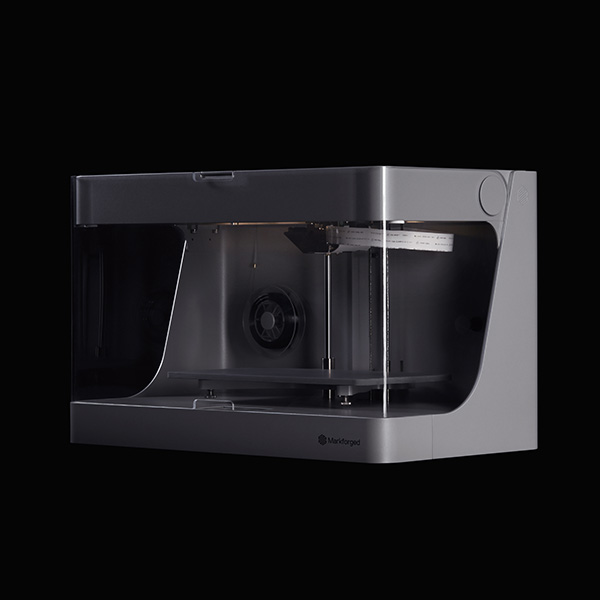
The Mark Two delivers best-in-class reliability with an aluminum chassis and precision-machined components. It measures just 584mm x 330mm x 355mm (23” x 13” x 14”) but provides a generous build volume of 320mm x 132mm x 154mm (12.6” x 5.2” x 6”). It has a kinematic coupling print bed that’s flat to within 160µm and Z-layer resolution of 100µm to 200µm.
Included with the printer: a dry box and accessories kit (bed-leveling shims, scraper, spare parts, and tools).
3D Printing Software
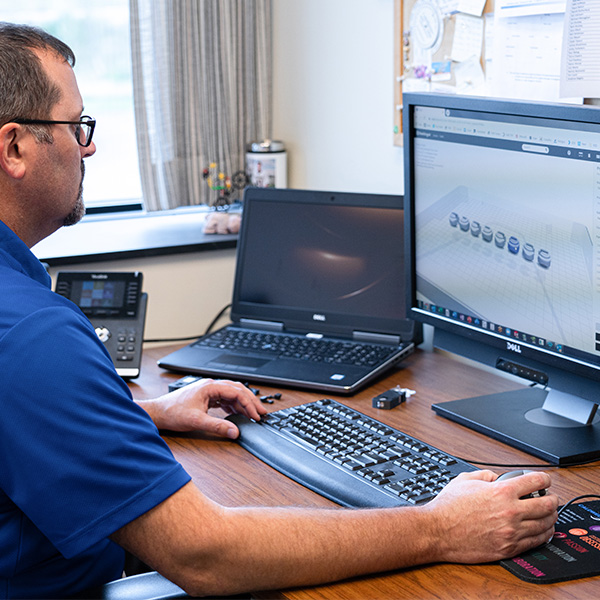
The Mark Two uses the Markforged Eiger cloud-connected software for slicing parts and managing workflows. Eiger’s intuitive interface makes it easy to use the CFF process to print parts based on CAD designs. The Eiger internal view enables designers to customize fiber routing to maximize the performance of the part.
Designers simply upload their 3-D designs into the Eiger software, select the continuous fibers and base materials, and use the one-click automated print prep option. They can also customize the settings by changing wall thickness, infill densities, layer heights, supports, etc. Eiger also features digital parts inventory and dashboard analytics for tracking print jobs and material usage.
3D Printing Technology
Thermoplastics are commonly used in 3D printing — the printer melts and extrudes them layer by layer to form the part. However, thermoplastics lack the strength, stiffness and heat resistance needed for engineering applications. Composite fibers are stronger, stiffer and more heat resistant than thermoplastics, but are used to reinforce other materials. By themselves, composite fibers can easily break if bent. CFF combines the two materials to create parts with strength comparable to aluminum.
The Mark Two features two nozzles. One nozzle forms the walls and closed-cell infill of the part using thermoplastic material. The second nozzle routes continuous fiber in the plastic according to the designer’s specifications. By heating and compressing the materials during extrusion, the Mark Two bonds the continuous fiber. Its heat deflection temperature of up to 140 degrees makes it possible to reinforce parts with high-temperature composite materials.
Use Cases
The Mark Two is suitable for a wide range of use cases, including initial and functional prototyping and high-quality custom tooling. It accelerates and reduces the cost of prototyping and iterating, and enables companies to quickly print replacement parts onsite.
The CFF process can also be used for soft jaws and welding fixtures. Metal parts can be replaced with 3-D-printed carbon-fiber-reinforced parts, also at significant time and cost savings. The parts are durable enough to handle corrosive fluids, clamping forces and high temperatures.
Why Saratech Recommends the Markforged Mark Two
The Markforged Mark Two makes it fast and easy to incorporate CFF into the additive manufacturing process. Designers can take advantage of various composite fibers and thermoplastic materials, including the Markforged Onyx micro-carbon-fiber-filled nylon product. With a simple interface and powerful software, the Mark Two is a complete solution for serious manufacturing and engineering use cases.
Frequently Asked Questions
1. What are the power requirements for the Markforged Mark Two?
The Markforged Mark Two operates on standard 110–120V single-phase power, making it easy to deploy in most office, lab, or shop environments without special electrical infrastructure.
2. Does the Mark Two require a dedicated ventilation or enclosure system?
No dedicated ventilation system is required for typical use. The Mark Two is designed for office- and lab-friendly environments when printing standard materials such as Onyx and composite fibers. However, good general room ventilation is recommended, especially in enclosed spaces or when running long print jobs.
3. Can the Mark Two be operated in high-humidity or dusty environments?
For best performance and material consistency, the Mark Two should be operated in a clean, temperature-controlled environment. High humidity can negatively affect material quality, particularly composite fibers, which is why the system includes a dry box to protect materials. Excessive dust should be avoided, as it can impact print quality and long-term reliability.
4. the Mark Two integrate with ERP or PLM systems?
The Mark Two uses Markforged Eiger, a cloud-based software platform that supports digital part storage, version control, and usage tracking. While Eiger does not provide native, out-of-the-box ERP or PLM integrations, many organizations integrate Markforged workflows into existing systems through process alignment, part naming conventions, and data export, or via custom integrations depending on IT requirements.
5. Is the Mark Two (Gen 2) backward compatible with older spools or accessories?
The Mark Two (Gen 2) maintains compatibility with supported Markforged materials and accessories, though availability and compatibility may vary by material generation. It’s recommended to verify specific spool types and accessories to ensure optimal performance and reliability with the Gen 2 hardware.
