

Engineering Services for Startups: What to Outsource at Each Growth Stage
Blog Article | October 16, 2026
Summary
Engineering outsourcing helps startups access specialized expertise, increase development capacity, and manage costs without building a full engineering team too early. This guide explains what to outsource at each growth stage, from technical validation and prototyping to product development, testing, manufacturing readiness, and R&D. Learn how to choose the right engineering support, balance outsourcing with internal hiring, and reduce risks as your startup grows.
Key Topics Covered
Introduction
Startups rarely have the budget or workload to build a complete engineering organization from day one. Founders may need to validate feasibility, build a prototype, prepare for manufacturing, or launch an MVP before several full-time engineering hires are justified. As the company grows, the challenge changes from proving the idea to scaling delivery, improving reliability, controlling product data, and supporting a larger customer base.
That is where product engineering services for startups can provide leverage. Outsourcing selected engineering work allows startups to access specialized expertise without immediately taking on the cost, risk, and management overhead of building every capability internally. Instead of hiring ahead of demand, a startup can bring in the right expertise when it is needed and adjust support as the product and business mature.
A pre-seed startup may need technical validation and rapid prototyping, while a seed-stage company may need development and testing capacity. By Series A, priorities often shift toward specialized expertise and roadmap acceleration. Later-stage companies may use external partners for modernization, surge capacity, ongoing support, or R&D.
The smartest outsourcing strategy evolves with the company.
What Startup Engineering Services Typically Include
Saratech supports startups developing complex physical and connected products by bringing engineering, software, manufacturing, and product lifecycle capabilities together. Depending on the product and growth stage, Saratech can help validate technical feasibility, develop and refine the product, prepare it for manufacturing, and establish the systems and processes needed to scale.
For physical or connected products, multiple engineering disciplines often need to work together, including hardware, electronics, firmware, software, manufacturing, and product data. An engineering partner can provide these capabilities without requiring a startup to build every function internally.
Common Services Include:
- Product discovery and technical feasibility analysis
- Product architecture and engineering strategy
- Industrial design and mechanical engineering
- Electrical and embedded systems engineering
- Software and firmware development
- Prototyping and MVP development
- Testing and quality assurance
- Cloud, DevOps, and infrastructure support
- Product lifecycle management
- Manufacturing and design-for-manufacturing support
- Product optimization and modernization
- Specialized engineering and technical consulting
Why Startups Outsource Engineering
Faster Execution
Technical consultants can join an initiative without lengthy recruiting and onboarding, helping startups move from concept to prototype or launch more quickly.
Lower Hiring Risk
A startup's engineering needs can change dramatically within months. Outsourcing adds capabilities without immediately committing to permanent headcount.
Access to Specialized Expertise
Some engineering disciplines are difficult to hire for or may only be needed for a specific project. An external partner can provide specialized knowledge when the roadmap requires it.
Better Capital Efficiency
Early funding needs to support product development as well as sales, marketing, operations, and other priorities. Strategic outsourcing can help startups allocate capital toward the highest-value activities.
Flexible Capacity
Startups rarely have perfectly predictable workloads. An external team can provide additional capacity during development sprints, product launches, or major engineering initiatives.
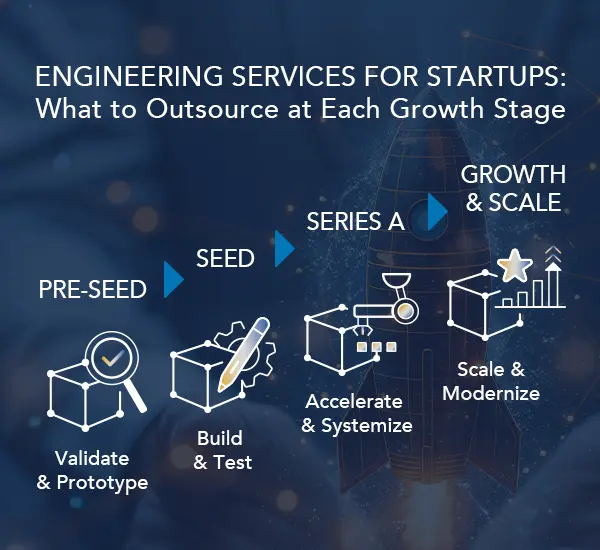
Why the Right Outsourcing Approach Depends on the Startup Growth Stage
A common mistake is treating outsourcing as a single strategy throughout the life of a startup.
At pre-seed, the priority is validating technical and commercial viability. Seed-stage companies focus on building and launching, while Series A companies need greater predictability and engineering scale. Later-stage organizations may have substantial internal teams but still need outside expertise for specialized projects or additional capacity.
The better question is not simply, “Should we outsource engineering?” It is, “Which capabilities are critical now, which provide competitive advantage, and which should we build internally as demand becomes predictable?”
What to Outsource at the Pre-Seed Stage
Pre-seed startups need speed, validation, and capital efficiency more than large permanent engineering teams. At this stage, outsourcing can provide the technical capabilities needed to turn an idea into something testable without creating an oversized organization.
Product Discovery & Technical Validation
Before investing heavily in development, startups need to determine whether the product can be built within their technical, financial, and time constraints. Engineering support can help evaluate requirements, identify technical risks, compare potential architectures, and determine what should be included in an initial product.
For hardware startups, this may include evaluating materials, components, manufacturability, electronics, mechanical requirements, and system integration. For connected products, it may also involve assessing firmware, software, connectivity, and cloud requirements. Many startups engage engineering partners during this stage to assess feasibility, identify technical risks, and create a realistic roadmap before investing heavily in development.
Prototyping & MVP Design
Whether the product is software, hardware, or a connected device, rapid prototyping can help founders gather meaningful user feedback while reducing development risk. Specialized expertise can help translate early concepts into prototypes that demonstrate core functionality and expose design problems before significant resources are committed. The prototype does not need every planned feature; it needs to answer the most important technical and user questions.
Initial MVP Development
Once the concept has been validated, startups can outsource development of the initial MVP while founders maintain ownership of product priorities and customer requirements. For startups developing physical or connected products, external engineering support may include mechanical design, electrical engineering, embedded systems development, software development, and planning for future manufacturing requirements. A disciplined engineering partner can help startups avoid spending early capital on features or infrastructure that have not yet been validated.
Fractional Technical Leadership
Some startups need experienced technical leadership before they need a full-time CTO or VP of Engineering. Fractional technical leadership can help establish engineering priorities, evaluate technology decisions, manage external development resources, and create a roadmap for building the eventual internal organization. This can be particularly valuable when founders have strong business or domain expertise but need additional technical guidance.
What to Outsource at the Seed Stage
Seed-stage startups usually need to launch, prove traction, and improve the product quickly. Engineering outsourcing at this stage should focus on increasing execution capacity while helping the internal team concentrate on the highest-value product decisions.
Product Engineering Execution
Once customers begin using the product, engineering priorities often shift from building core functionality to responding to user feedback, fixing issues, and delivering enhancements that improve adoption and retention. An external product engineering team can supplement internal developers or own defined areas of the roadmap. This can help the company increase development velocity without immediately doubling its permanent headcount. For physical products, support may extend from engineering refinement through manufacturing preparation and production readiness.
QA & Testing
Testing is often one of the first capabilities that gets squeezed when a startup is under time pressure. That can become expensive after launch. External QA and testing support can provide structured validation without requiring the startup to immediately build a large internal quality organization. Depending on the product, this may include functional testing, integration testing, performance testing, hardware validation, or system-level testing.
DevOps & Release Support
As a startup moves from MVP toward a production product, deployment and infrastructure can become increasingly complex. External DevOps expertise can help establish more repeatable build, test, deployment, and monitoring processes. For connected products, this may also include cloud integration, device management, firmware updates, and connectivity testing.
Specialized Engineering Needs
Seed-stage companies frequently encounter technical requirements that their core team does not yet have the expertise to handle. Startups can outsource specialized work such as embedded systems, mechanical and electrical engineering, cybersecurity, cloud architecture, data engineering, or manufacturing engineering. Working with a multidisciplinary engineering partner can simplify coordination when projects require expertise across software, hardware, manufacturing, and product development disciplines. This provides access to expertise without forcing the company to maintain full-time capacity for every discipline.
What to Outsource at the Series A Stage
Series A companies need more predictability, stronger systems, and a clearer build-versus-buy strategy. The engineering organization is becoming more established, but the product roadmap is often expanding faster than internal hiring can keep up.
Specialized or Hard-to-Hire Roles
Some capabilities remain difficult to recruit even after a company has established a strong engineering organization. External specialists can fill those gaps while internal recruiting continues—or provide expertise for initiatives that do not justify permanent headcount.
Feature Acceleration
A growing customer base creates pressure to deliver more functionality without sacrificing quality. Multidisciplinary teams can work alongside internal engineers on well-defined roadmap initiatives, allowing the organization to increase throughput while preserving internal ownership of product strategy.
Design System & Product Refinement
As a product matures, inconsistencies that were acceptable in an MVP can become expensive. Engineering support at this stage can focus on improving product architecture, refining interfaces, eliminating technical debt, standardizing components, and improving the overall user or product experience. For physical products, refinement may include design optimization, component consolidation, reliability improvements, or design-for-manufacturing changes.
Process & Delivery Support
As startups grow, engineering teams often need more structure to maintain development velocity and product quality. Stronger product data management, documentation practices, and lifecycle processes become increasingly important for maintaining efficiency and product quality as engineering organizations mature. An engineering partner can improve these processes while internal leadership builds the long-term organization.
What to Outsource at the Growth & Scale Stage
Later-stage startups often need outside support for leverage, not simply basic execution. External resources can provide additional expertise, capacity, or perspective without disrupting the core team.
Overflow & Surge Capacity
Product launches, major releases, acquisitions, or unexpected customer demand can create temporary engineering spikes. Instead of hiring permanent employees for a short-lived workload, companies can use external teams for surge capacity.
Infrastructure & Modernization Projects
Growing products often accumulate technical debt and legacy systems. External specialists can support modernization initiatives, system migrations, architecture improvements, automation, or infrastructure upgrades while internal teams continue maintaining the core product. Some organizations also use external partners to evaluate product development processes, eliminate bottlenecks, and improve engineering efficiency as they scale.
Ongoing QA, Support, & Maintenance
Mature products require continuous attention. Engineering experts can provide ongoing testing, maintenance, bug resolution, product updates, or technical support. This can free internal engineers to focus on strategic development and new product initiatives.
Emerging Initiatives & R&D
Established startups also need to experiment. An external engineering partner can investigate new technologies, develop proofs of concept, explore new products, or validate innovations before the company commits significant internal resources. This creates a flexible path for experimentation without distracting the core organization.
Get the Engineering Expertise to Move Your Product Forward
What Startups Should Usually Keep In-House
Outsourcing provides flexibility, but startups should retain ownership of the decisions that define their competitive advantage and long-term product direction. The principle is simple: outsource execution and specialized capacity strategically, but keep strategic ownership close to the business.
- Product vision and strategy
- Customer and market knowledge
- Core intellectual property
- Product prioritization
- Critical architectural decisions
- Key technical knowledge that differentiates the product
- Final decisions about roadmap, quality, and business priorities
Common Outsourcing Models for Startups
Different Stages Call for Different Engagement Models
Project-Based Outsourcing
A project-based model works well for clearly defined deliverables such as a prototype, engineering analysis, product redesign, or specific development initiative, with scope and timelines established upfront.
Dedicated Team Model
A dedicated team provides engineers who work continuously on the startup's product. This can be useful when the company needs sustained engineering capacity but does not yet want to build the entire team internally.
Team Augmentation
Team augmentation adds external specialists directly to an existing internal organization. It works particularly well when the startup has engineering leadership and product direction in place but needs additional capacity or expertise.
Fractional Leadership or Advisory Support
Fractional technical leadership provides experienced guidance without the cost of a full-time executive. This can help early-stage founders make technology decisions, establish engineering processes, evaluate vendors, and plan the transition toward an internal engineering organization.
Team-as-a-Service Model
A team-as-a-service model provides an ongoing, flexible engineering capability that can expand or contract based on the roadmap. It offers a middle ground between project outsourcing and building a large permanent team.
How to Decide What to Outsource vs. Hire Internally
The Decision Depends on the Startup’s Product, Funding, Roadmap, & Long-Term Strategy
Outsource Work That Is Specialized, Urgent, or Not Yet Full Time
If a capability is highly specialized, needed immediately, or only required for a limited period, outsourcing may make more sense than hiring.
Keep High-Context Strategic Ownership Internal
If a role requires deep knowledge of customers, proprietary technology, product strategy, or the company's competitive advantage, keeping that expertise internally is usually preferable.
Consider Burn Rate, Roadmap Certainty, & Hiring Timelines
Before hiring, consider whether the workload is predictable enough to support an ongoing commitment. If recruiting will take six months but a critical project needs to begin next month, external support can bridge the gap.
Match the Engagement Model to Your Current Stage & Goals
There is no universally best outsourcing model. A pre-seed company might need fractional leadership and a project-based prototype team. A seed company may benefit from a dedicated engineering team. A Series A company may primarily need team augmentation and specialized expertise. The engagement should fit the business—not the other way around.
Risks to Avoid When Outsourcing Engineering
Outsourcing Engineering Does Introduce Risks, Particularly When Expectations & Ownership Are Unclear
Outsourcing Without Clear Product Direction
An external team cannot compensate for an undefined product strategy. Establish requirements, priorities, success criteria, and decision-making responsibilities upfront.
Choosing a Partner Based Only on Price
The lowest hourly rate does not necessarily produce the lowest total cost. Poor communication, rework, delays, and quality problems can quickly outweigh an initial price difference.
Weak Communication & Unclear Ownership
Define ownership of product decisions, technical decisions, documentation, testing, and approvals. Make regular communication part of the engagement.
Over-Relying on External Teams for Core Strategic Knowledge
External engineers should strengthen the organization without creating a permanent dependency on outside knowledge.
Failing to Plan for Future Internal Hires
If the startup eventually intends to build an internal engineering organization, the outsourcing strategy should support that transition. Documentation, knowledge transfer, source control, architecture records, and clear ownership can make future hiring and handoffs significantly easier.
Conclusion
Startups do not need to hire every engineering function at once. A smarter approach is to outsource the right engineering work at the right growth stage.
Pre-seed startups can use external expertise to validate ideas, prototype products, and establish technical direction. Seed-stage companies can add development, testing, DevOps, and specialized engineering capacity. Series A organizations can use external teams to accelerate features, fill specialized roles, and strengthen processes. Growth-stage companies can turn to engineering partners for surge capacity, modernization, ongoing support, and R&D.
Every startup's engineering needs evolve as the business grows. The challenge is not deciding whether to outsource engineering, but determining which capabilities should be built internally and which can be supplemented with external expertise at each stage. For startups evaluating product development support, engineering services, or specialized technical expertise, partnering with an experienced engineering team can help accelerate development while reducing risk.
Key Takeaways
-
Outsourcing engineering helps startups access specialized expertise, increase development capacity, and manage costs without hiring a full engineering team.
-
Pre-seed startups can outsource technical validation, prototyping, MVP development, and fractional technical leadership to reduce risk before making major investments.
-
Seed-stage startups can add product development, QA and testing, DevOps, and specialized engineering support to prepare for launch and improve product quality.
-
Series A startups can use external engineering teams to accelerate roadmaps, fill hard-to-hire roles, refine products, and improve development processes.
-
Growth-stage startups can outsource surge capacity, modernization, ongoing maintenance, and R&D to support scaling without overextending internal teams.
-
The right outsourcing model depends on your needs, from project-based engagements and team augmentation to dedicated engineering teams and fractional leadership.
-
Startups should retain ownership of product strategy, customer knowledge, core intellectual property, and critical decisions while outsourcing specialized work and execution capacity.
-
Clear requirements, communication, documentation, and knowledge transfer help reduce outsourcing risks and support long-term growth.
