

A Vortex Crosses the Pressure Opening Warning
Blog Article | May 3, 2022
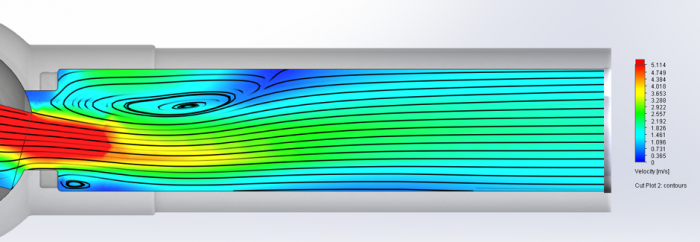
During CFD simulations, encountering a warning message that states "A vortex crosses the pressure opening" can be unexpected. This warning indicates the presence of recirculation at the edge of a pressure boundary, which can potentially lead to incorrect simulation results. Addressing this issue is important for ensuring the accuracy and reliability of your simulations. In this blog article, we will delve into the details of this warning and provide practical solutions to resolve it in FloEFD. Whether it's extending the domain size, refining the mesh, or conducting a time-dependent analysis, we’ll guide you through how to mitigate this warning and achieve more precise outcomes in your simulations.
Summary
Warning in the calculation window saying, A vortex crosses the pressure opening warning.
Details
At a pressure boundary you have some recirculation at the edge of the domain. This can lead to incorrect results.
During simulations a warning can pop up saying a vortex is crossing a pressure opening, this means, you have some recirculation at the edge of the domain. This can lead to incorrect results.

Ensure Your Products Perform as Expected With CAE Services From Saratech
Get Started With a Quote
There Are a Few Ways This Can Be Fixed in FloEFD
There are a few ways this can be fixed in FloEFD:
Extend the domain size to calculate all the recirculation properly. This allows FloEFD to resolve the recirculation region and more accurate results will be seen with the expected flow characteristics:
It may be possible that the mesh is too coarse to capture all the effects of the flow in that region, using a local mesh region will allow just this region to be refined.
There may be some flow and overall physics which show time-dependent effects which can result in the goals oscillating and causing this warning. In this case, you may try to do a time-dependent analysis to further observe these effects and to obtain direct physical time-dependent results.
It may be that for the geometry and boundary conditions, this behavior is correct and further investigation is required.

